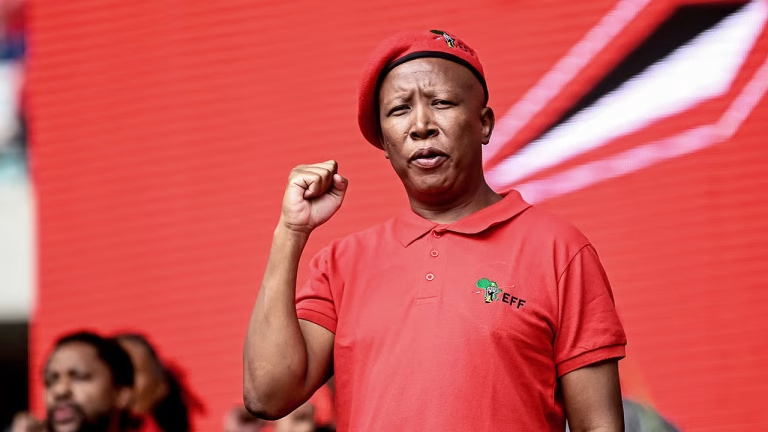
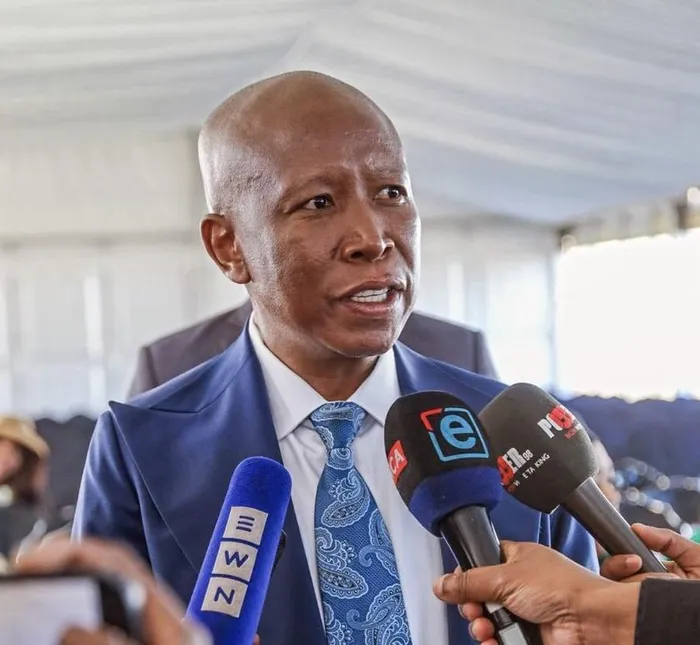
On Thursday, April 16, 2026, the East London Magistrate’s Court (now often referred to locally as KuGompo) delivered a historic ruling that has reshaped the South African political horizon. Julius Malema, the Commander-in-Chief of the Economic Freedom Fighters (EFF), was sentenced to five years of direct imprisonment for the unlawful discharge of a firearm during a 2018 political rally.
The sentencing marks the culmination of an eight-year legal odyssey that began at the Sisa Dukashe Stadium in Mdantsane. While the State had aggressively pushed for a maximum sentence of 15 years, Magistrate Twanet Olivier opted for a five-year term, emphasizing that public office bearers must be held to a higher standard of accountability.
The Sentencing Breakdown
Magistrate Olivier delivered a detailed judgment, dismissing the defense’s earlier arguments that the weapon used was a “toy” or a theatrical prop. The court found Malema guilty on five counts, with the following sentencing structure:
- Count 1 (Unlawful Possession of a Firearm): 5 years’ imprisonment.
- Count 2 (Unlawful Possession of Ammunition): 2 years’ imprisonment.
- Counts 3, 4, and 5 (Discharging a Firearm and Reckless Endangerment): Fines of R20,000 or six months’ imprisonment for each count.
Crucially, the court ordered that the sentences for Count 2 and the other charges run concurrently with the five-year term for Count 1. This means the effective prison sentence handed down to the EFF leader is five years.
“The Event of Evil”: The Magistrate’s Scathing Remarks
In a courtroom packed with red-shirted EFF supporters and high-ranking party officials, Magistrate Olivier was uncompromising in her assessment of Malema’s conduct. She rejected the notion that the shooting was a “celebratory gesture” that should be overlooked.
“Discharging a firearm in a public area and calling it a celebratory shot is still a crime, no matter the reason. Clearly, planning of this nature is against the law… It was dangerous, it was the event of evil, and there lies the difference.” — Magistrate Twanet Olivier
The court noted that as a Member of Parliament and a leader followed by millions of young South Africans, Malema’s decision to fire an assault rifle into a crowded stadium set a “dangerous and unlawful” precedent that the judiciary could not tolerate.
The Appeal and the “Stalingrad” Strategy
The sentencing was immediately met with a legal counter-strike. Malema’s defense team, led by Advocate Lawrence Hodes (SC), applied for leave to appeal the ruling.
- Leave to Appeal Granted: Magistrate Olivier granted Malema leave to appeal the sentence but denied leave to appeal the conviction itself.
- Status of the Sentence: Because leave to appeal was granted, the five-year prison sentence is effectively suspended pending the outcome of the appeal in a higher court.
- Release on Warning: Malema was released on a warning and did not have to pay bail, but he remains bound by the court’s commitments until the appeal process is finalized.
Political analysts have noted that this could be the beginning of a protracted “Stalingrad defense”—a series of appeals and petitions to higher courts, including the Supreme Court of Appeal and potentially the Constitutional Court, which could keep Malema out of prison for several more years.
Political Consequences: A Threat to Parliament
Despite the pending appeal, the legal reality for Malema is stark. Under the South African Constitution, any person sentenced to more than 12 months in prison without the option of a fine is prohibited from serving as a Member of Parliament.
While this disqualification only kicks in once all appeal processes are exhausted, the conviction hangs like a Damocles sword over Malema’s political future. Should the High Court uphold the five-year sentence, the EFF would face the unprecedented challenge of navigating a national election cycle without their founding leader in the National Assembly.
Reaction: A Divided Nation
The verdict has drawn sharp reactions across the political spectrum:
- Democratic Alliance (DA): Leader Geordin Hill-Lewis welcomed the sentence, calling it a “good day for the rule of law” and a victory against the culture of impunity among the political elite.
- AfriForum: The civil rights group, which was instrumental in pushing the private prosecution and monitoring the case, described the five-year term as an “essential message” that no one is above the law.
- The EFF: The party has labeled the sentencing a “political provocation” and a “racist” attempt by the judiciary to silence a voice of the poor. Outside the court, Malema remained defiant, telling supporters, “They will never imprison my ideas.”
Conclusion: The Long Road Ahead
As Julius Malema returned home on the evening of April 16, he did so as a man sentenced to prison but legally free to continue his work. The battle now moves from the Magistrate’s Court to the higher halls of the South African judiciary.
The coming months will determine whether this five-year sentence marks the beginning of the end for Malema’s storied career or if his legal team can successfully dismantle a conviction that the State believes is ironclad. For now, the “Commander-in-Chief” remains in the fight, but the court has made it clear: the rule of law in South Africa has a long memory and a heavy hand.
Do you think the granting of leave to appeal is a fair application of the law, or does it simply allow politicians to delay justice indefinitely?
About the Author